Fitness Exposé

Bodybuilding Secrets Exposed

  • Facebook
  • Flickr
  • LinkedIn
  • Pinterest
  • RSS
  • Twitter
  • YouTube
  • Home
  • Articles
    • Training
    • Diet & Fat Loss
    • Supplements
    • Experiment
    • News
    • Resources
    • Reviews
    • Contest Prep
  • Podcast
    • Fitness Freedom
  • Coming!
You are here: Home / Archives for 2009

Archives for 2009

Combat the Fat Week 6 Update

August 17, 2009 By Michael Mahony, ISSA CPT 2 Comments

I just completed the sixth week of my Combat the Fat training program.  I have gotten into a nice rhythm with this program.  I lost 3 pounds this past week by increasing the intensity of the cardio just a little bit.  Using the techniques I’ve learned via the Experiment of One, I managed to burn off more fat than Week 5.  While this program is really great exactly the way it is, I’ve realized that the cardio portions are not updated each 4 weeks the way the training portion is and so I tweaked it.

Reason for Tweaks

The weight training portions of this program are made more difficult every four weeks. When you start the program you pick a level (I started at Advanced Level 1) and then you progress from there every 4 weeks.  The cardio portion of this program does not adjust according to your level of fitness.  I realized that I was not getting the kind of results I’d want from a program like this, so I increased the intensity of the cardio just slightly.  I changed up the order of exercises I was doing on cardio day to maximize the heart rate increase that I am getting.  This appears to have worked, so let’s see what Week 7 brings.

The cardio portion of this program is not extremely difficult, but it is extremely effective at burning fat.  You will find that you don’t get bored by the cardio at all.  It keeps you moving and that’s a great thing.  I can do the entire hour without any music and I still manage to get through it like it is nothing.

Nutrition

This is one of the few programs that allows you to eat carbs in a portioned out manner.  I have found through various experiments that I am extremely carb sensitive, so I will be cutting back on carbs this coming week to see if I can push the results even further.  With 6 full weeks to go, I am looking to make a major push through the second half of this program.  The results I am going to get are going to be massive.

Accountability

I have returned to accountability blogging and I am hoping that everyone who reads this article will become a daily visitor to my accountability blog, the Muscle Building Fat Burning Machine.  Your comments on that blog let me know that you are holding me accountable and that, in turn, helps me make better decisions throughout the day.  I post a VLog daily along with accountability photos.  Please visit as often as you can and leave comments.

I am also doing a Combat the Fat weekly update right here (you are reading one right now, in case you were not aware).  Please also comment on these updates as they also help to keep me accountable going forward.

Going Massive

As mentioned, I am stepping it up and going massive for the next 6 weeks. I am already planning what I will do for training once the next 6 weeks is complete.  This is an important point to take from this article—success requires planning and planning cannot be done at the last minute and be as effective as it should be.  Get your plans in motion far enough in advance and your success is just about a lock.

Related Posts:

  • Combat the Fat Week 7 Update
  • Combat the Fat Week 12 Update
  • Combat the Fat Week 5 Update
  • Climbing Pyramids
  • Why You Need to Lift Heavy

Filed Under: Training

M8:D43 (D660) Turning Things Around

August 17, 2009 By Michael Mahony, ISSA CPT Leave a Comment

The Muscle Building Fat Burning Video Blog #102
August 16, 2009


What's on my mind today?

In the past month alot of things have happened that threw me off course.  My training has been good, but I would not say it was excellent.  My nutrition has been above average/excellent.  Things have gotten easier in that area, but I can now say without a doubt that I am carb sensitive.  I’ve conducted many experiments with nutrition and I have truly determined that I just have to keep carbs lower than most people in order to see results.

Today I am turning things around.  I am back to accountability blogging after twice deciding to quit.  I am going to be using a regular publishing schedule to get things done.  I am also back to posting my daily photos.  I am ratcheting up the accountability and I plan to be shredded by September 30, 2009.  That’s right, I will be posting massive results in just 45 days from now.   You will want to be here reading what I am up to. 

I will continue to educate through this blog.  I will share the things I am learning and give suggestions for how you can apply those things to yourself.  I will continue to chronicle my son, Matthew’s, progress through his own fitness program.  I have also taken on a new person to be a mentor to with the help of Carlos DeJesus. You will want to be reading this space to follow what is going on.

Please make sure to comment and let me know you are here.  I am going to need your help in holding myself accountable.  Please be there for me.

I am seriously turning things around and this is going to be the final time I have to do so.  I have had major discipline, but the accountability blogging severely slipped after a long stretch of being good with it.  I am looking for your support, so please help out.

 
Find out what I'm doing to my body!

 
Today was a rest day.  I am currently working through the Combat the Fat program by Jeff Anderson. This program consists of the following training schedule:

Monday – CTF Pyramid Training (A – Back/Arms/Shoulders/Legs)
Tuesday – CTF Low Intensity Interval Training (60 minutes)
Wednesday – CTF Circuit Training
Thursday – CTF Low Intensity Interval Training (60 minutes)
Friday – CTF Pyramid Training (B – Arms/Chest/Back/Abs)
Saturday – CTF Low Intensity Interval Training (60 minutes)

This program is aimed at using military principles to burn fat over a 12 week period of time.  It has been alot of fun.  It uses progressive overload principles built into 4 week periods.  I highly recommend this program.


Until tomorrow…GET BACK TO LIFTING!

Follow the Muscle Building Fat Burning Machine on Twitter!


Get the Cure for Fitness Information Overload Now!

Feeling overwhelmed by the information you get on the web?  Not sure if that guy is a "guru”?  The answer is finally here!
Free eNewsletter and basic fitness eCourse just for visiting!

Fitness Expose Banner

https://www.fitnessexpose.com

Related Posts:

  • No Related Posts

Filed Under: Fitness

Review: The Quad Blaster

August 14, 2009 By Michael Mahony, ISSA CPT Leave a Comment

Several years ago I had lower back surgery to repair a ruptured disc.  As a result of that surgery, I’ve been continually concerned with potential injuries to my back.  At the same time, I want to make my quads grow larger.  Everyone told me to squat and squat heavy in order to gain quad size. 

I gave the squat idea a try, but every time I got to a higher weight where I could really work my quads, I’d get a muscle spasm.  I’ve come to decide that those injuries were caused by my fear of getting hurt.  As Skip Lacour would say, I let my head take over when my body should have.  Whatever the cause, I was very hesitant to do squats as a result of all the problems I’d experienced.  I thought all hope was lost until…enter the Quad Blaster.

image

The Quad Blaster is a very simple, but effective device for growing your quads.  It can completely replace the squat in your workout routine or just supplement it.  Alwyn Cosgrove has called the Quad Blaster an iso-compound exercise because it works like a compound movement and an isolation movement at the same time.

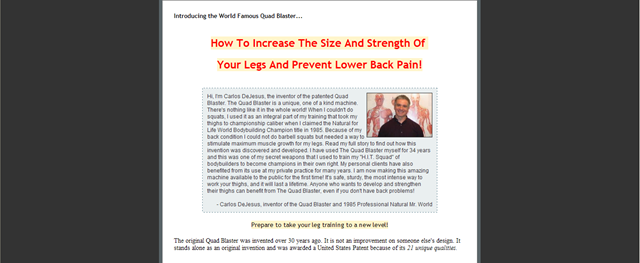
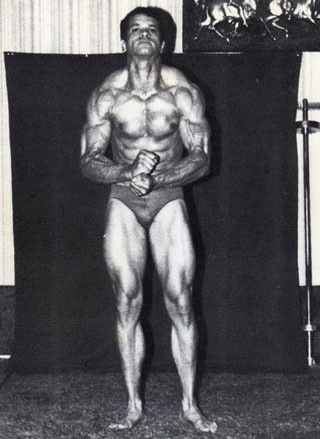
This device was invented and patented by Carlos DeJesus, a world champion natural bodybuilder.  Carlos used this device to grow massive thighs during his competition years.

carlospose

Carlos had suffered from lower back pain and was trying to find ways he could squat without pain.  Eventually he was diagnosed with a degenerative disc disease which meant no more barbell squats for him.  He was a competitive bodybuilder and knew he was going to need something good to make his quads grow. 

As a result of his own personal issues, Carlos invented the Quad Blaster in 1974.  By 1979 he had the plans copyrighted and in 2000 he had the device patented. 

Through the use of the Quad Blaster, Carlos was able to win the 1981 Natural Mr. USA, the 1981 Natural Mr. North America and the 1985 Professional Natural Mr. World.

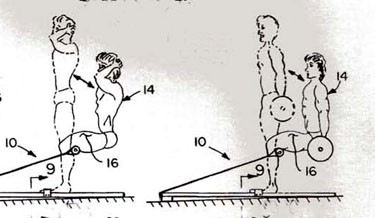
When I first tried the Quad Blaster I was pretty amazed at how well it worked my legs with just my own body weight.  You get into the machiquadsketchne with your feet close together.  It mimics a narrow stance squat, which is an extremely quad-dominant exercise.  Your body travels in a very vertical stance.  You are able to add weight as necessary to increase the intensity of the exercise.  You can either hold a dumbbell in the front or a barbell in the back to make this an extremely intense exercise.   If you stick to proper form a 50 lb. dumbbell will be extremely difficult for you to complete. 

I started using the Quad Blaster and after 24 weeks I had increased my quads on both sides by more than 2 inches.  The definition I got was incredible as well.  I now use the Quad Blaster in all of my leg workouts.  It works as advertised.  To quote the sales page, the Quad Blaster is:


  • Intense.  This is the most intense workout for the thighs.  Don’t be decieved by the simplicity of this machine. Once you’ve tried it, nothing else compares.
  • Safe.    You don't need to put heavy-duty weights on your back. Because of the beauty of design, The Quad Blaster generates immense difficulty through leverage so that holding a 10-pound dumbbell translates to 200 pounds to your thighs. This will save your back and knees. It's so well designed that even put through the worst of trails by a World Champion; even he couldn't damage or break it, even with years of use.
  • Portable/Light Weight.  Because the total weight is about 15 pounds The Quad Blaster is easily portable and perfect for travel. The side handle makes it easy to pick up and go. Most will especially appreciate this feature. Not exactly what you can do with a bulky machine!
  • Compact.  The Quad Blaster is compact enough that it fits in the back seat of your car, in the trunk, or under your bed.
  • Affordable.  Priced so that everyone can afford one. There are three ways you can get one. Pick the one that is right for you so you can jump-start your leg training by having your very own Quad Blaster.

If you want some serious quad growth, get yourself a Quad Blaster.  You will not be sorry that you did. 

You can buy one full assembled, buy a kit that you assemble yourself or you can buy the plans to do the entire thing on your own.

quadblaster_ecover_final2

Related Posts:

  • Fitness Expose Recommends #1 – Tom Venuto Interviews Carlos DeJesus
  • Squatting for Bigger Quads
  • Saturday Sharing: My Opinion on HIT Training
  • My Weight Training Methods, Part 2
  • How an Old Guy Uses Intensity

Filed Under: Reviews

Joint Venture or Monetization Scheme?

August 12, 2009 By Michael Mahony, ISSA CPT Leave a Comment

Today I was pondering something regarding the fitness industry and it inspired me to write this post.  As most of you know, the fitness industry is a multi-billion dollar industry.  There is alot of money to be made by someone with a large list of prospects.  A common teaching of internet gurus is to get involved with a joint venture (JV) to assist with building your list of prospects. 

I am active on Facebook and Twitter and enjoy interacting with people in both places.  From time to time I get joint venture offers on Facebook.  I’ve generally ignored them for a multitude of reasons.  For some reason this past week I decided to investiate one.  I believe what inspired me is the fact that this joint venture is aimed directly at fitness professionals. 

I filled out the form for this “free” joint venture opportunity and hit the submit button.  I was taken to a page that began to pitch me on buying into another part of the joint venture opportunity.  By spending $17 I would be guaranteed a place in the joint venture opportunity.  I would get special preference for placement on the joint venture page when the launch occurred.  I decided that I did not want to spend $17, so I clicked the “no thanks” button.  Amazingly, I was sent to an almost identical pitch page that told me that I could get the same thing for just $7. 

Think about what I just told you.  What would have happened if I had decided to pay the $17 right off the bat?  I would have paid $10 extra for something that I could have gotten for $7.  To me, that is a rip off, plain and simple.  I’m betting you wonder why I am bringing this topic up.  I bet you are not seeing the connection to the fitness industry in general.

Well, my friend, this is becoming more and more common in the fitness industry.  It is not just happening with joint venture opportunities.  Fitness gurus are offering their products at $89.95 and when you say you don’t want it (by either clicking on “no thanks” or by trying to navigate away from their site) they offer to sell you the program for $49.95.  That’s right, just for saying no you save $40.00.  This bothers me.

If you are really selling your product for $49.95 just do so right up front.  In fact, I think people should offer their product at a price they want and then allow the customer to add or subtract from the price if they feel the product is either worthy of more money or so bad that it should have cost less money.  This will force the gurus to make products that are effective and do what they claim they do.  It is a new form of a guarantee.

As the consumer, you can get this to happen.  If you try a product and don’t feel it lives up to the hype, return it for a full refund and then communicate to the author what you feel the program was really worth. Tell the author that you would have paid another amount had that offer been available.  If enough people were to do this it would soon become a method for paying on programs.  The authors would then work very hard on their product because they’d want to maximize their income.  Everyone would win.

Related Posts:

  • Massnutrition.com: Stay away if you know what’s good for you!
  • Use Your Head
  • New Workout or Old Idea?
  • FTC to Monitor Blogs for Claims and Payments
  • Take Your Time

Filed Under: News

Mobility vs Flexibility – Part 2

August 11, 2009 By Narina 1 Comment

In our last newsletter, we discussed mobility vs flexibility and how our bodies are a collection of joints, some requiring mobility and others requiring stability.  We covered the need for mobility through the ankle and the hip.  In this newsletter we are going to talk about knee stability, thoracic mobility, and shoulder health.

The knee demands stability.  The knee as a joint has very little rotational ability.  It's movement is basically that of a hinge.  Basic movements that require this hinging movements of the knee are squats and dead lifts.  Most issues involving pain in the knee are usually the result of a dysfunction either above or below.    Solve the ankle mobility problem and a lot of knee issues will clear up.   Start looking at mobility of the hip and the knee will benefit.

The thoracic spine or mid back area is not as well studied yet as some of the other areas such as hips, lumbar spine and knees.  It is however, proving to be a critical component in maintaining a healthy lumbar and cervical spine.   For the golfers out there, this is especially important.  In the golf swing you need you need to be able to separate the upper body from lower body.  During the backswing your pelvis needs to be stable allowing the shoulders to turn.  If you are unable to separate the upper and lower body, you will be limited as to how much shoulder turn you can perform.  This is where thoracic mobility is important – to allow movement through the back while keeping the pelvis stable.

Last but not least is the shoulder or gleno-humeral joint.   Also closely connected to the health of the shoulder is the area of the shoulder blade (the sacpulo-thoracic joint).  You cannot discuss shoulder health without talking about the stability of the shoulder blades which directly reflects the health of the rotator cuff.  The scapula, rotator cuff and shoulder is an area that whole exercise physiology textbooks are written about.  In order to have a shoulder that allows mobility, you need to have a stable base first.    Without a stable base provided by the scapular muscles, the shoulder joint can become quite immobile, causing decreased range of motion and pain. 

?
The scapular stabilizers (lower trapezius, rhomboids, serratus, levator scapula) are responsible to hold and lock the shoulders in the right position for the shoulder to function properly.    Some of the exercises that we use to strengthen these various muscles are as follows.  All rowing movements will help to strengthen the trapezius and rhomboids.  We will instruct clients to pinch the shoulder blade prior to initiating any rowing movements.  When you pinch your shoulder blades together, the rhomboid muscles in the middle of your upper back activate.  These muscles originate along the spine (C7 and T1) and then attach themselves to the inner border of your shoulder blades.  The pinching action will pull the shoulder blades together and this in turn with other muscles throughout the upper back and shoulder (rotator cuff) will cause the shoulder to sit in an anatomically correct position allowing proper function of the shoulder.

Other exercises that benefit the shoulder joint are the lat pull down and prone trap raise.  We also have variations along those exercises that we use (stiff arm pull downs, high pulley rows).   Often with these exercises we will instruct clients to “pull their shoulders to their hips”.  This prevents the shrugging so often seen with these exercises and once again helps to maintain the shoulder in a healthy position.  The muscles primarily responsible for this are the middle and lower trapezius.  The trapezius muscle is a large muscle that originates at the skull , the spine of C7 and all the thoracic vertebrae .  It then inserts along the rear of the shoulder, the scapular spine and part of the clavicle.  The  trapezius muscle's main responsibility is to keep the scapula down (no shrugging) and to maintain stability to allow shoulder mobility.

So, this is starting to turn in Anatomy 101 and I may have gotten a bit off track.  The scapular and shoulder, as I mentioned are worthy of a book on their own.  I am sure either you personally or someone you knows has had, does have or will have shoulder problems.  It is probably the most common problem we see in  and out of the gym.  And because of so much of what we need to do the keep healthy and strong, involves the shoulder, we much be diligent about the work necessary to keep the this joint healthy.

Till next time,

Narina Prokosch, RN CPT

“Monitoring, Mentoring, Motivation”

Related Articles:

Mobility vs. Flexibility, Part 1 –  What's the Diff?

Movement Matters

Related Posts:

  • Mobility vs Flexibility, Part 1 – What's the Diff?
  • Y3T Training System: Looking Back
  • How to Use Active Stretching
  • The Role of Time Under Tension
  • Movement Matters

Filed Under: Experiment of One

  • « Previous Page
  • 1
  • …
  • 10
  • 11
  • 12
  • 13
  • 14
  • …
  • 45
  • Next Page »

News

Toronto Pro Supershow 2016

June 12, 2016 By Michael Mahony, ISSA CPT Leave a Comment

IFBB Arnold Africa 2016

June 9, 2016 By Michael Mahony, ISSA CPT Leave a Comment

IFBB California Pro 2016

June 5, 2016 By Michael Mahony, ISSA CPT Leave a Comment

Coming Soon!

Featured Video

Regaining Focus!

Find out what I am doing to regain my focus.

We Recommend

Increase the internal rotation of your shoulder with the Rotater

New eBook!

Copyright © 2026 by Fitness Expose